
Moving Beyond the Mat: The 4 Foundations of Mindfulness
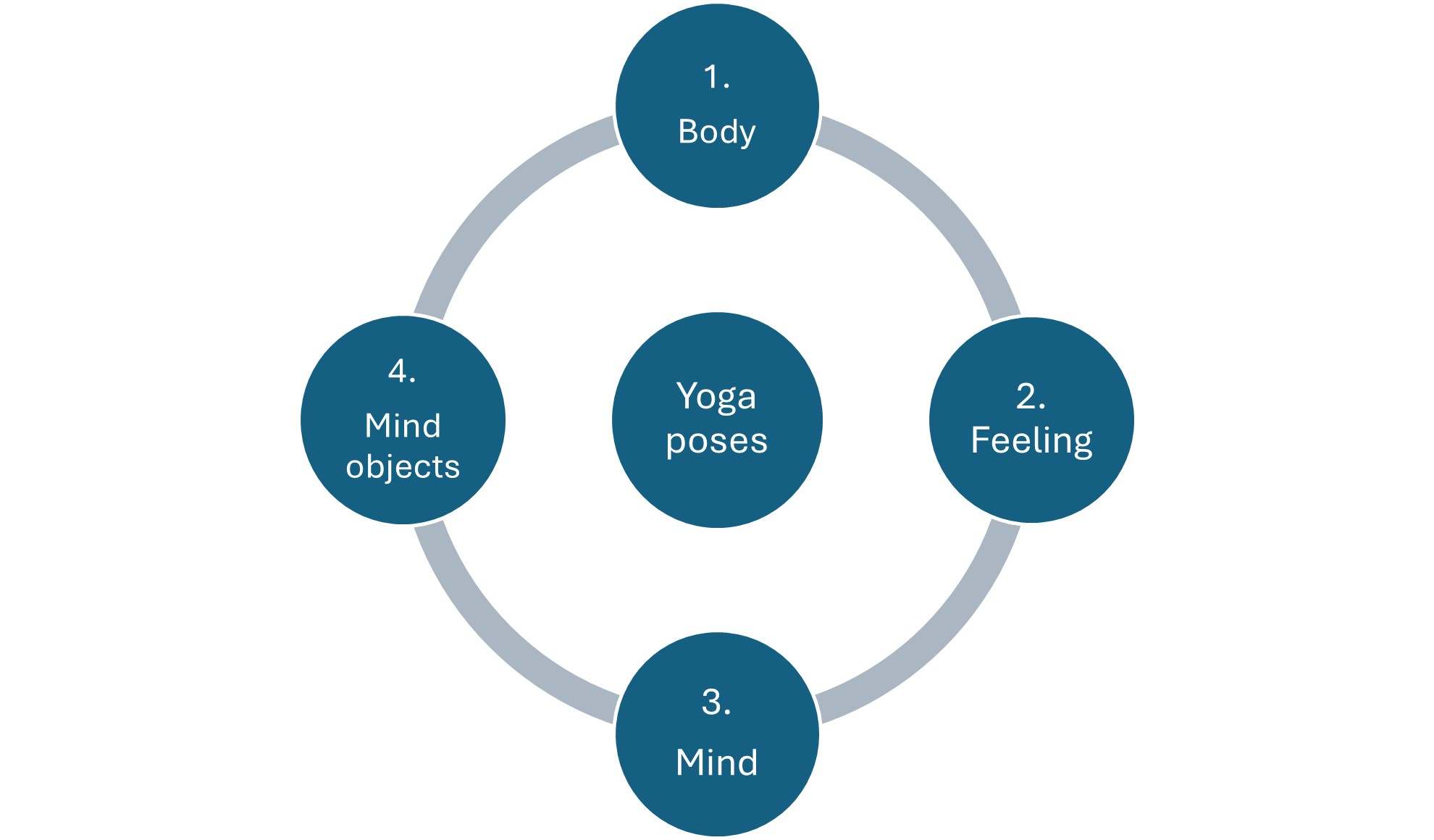
The Four Foundations of Mindfulness (from the Buddhist Satipatthana Sutta) are a core framework for meditation and daily awareness. They teach practitioners to observe the entire scope of human experience—the body, sensations, the mind, and mental phenomena—with clarity and non-judgmental acceptance. My yoga practice is entirely insipired by this incredible Buddhist teaching, which whether you are a Buddhist or not, will serve you well in your yoga practice and daily life. But what is it exactly and how does this concept helps us in our Yoga practice?
1. Mindfulness of the Body (Rupa)
This foundation anchors your attention in the physical realm. Instead of just living "in our heads," you bring awareness to what is happening physically. In yoga, we use our breath to bring mindful awareness to every pose moment by moment through the breath and body in all its constituent parts. How to apply in our yoga practice:
- Breathing: Simply observing the inhale and exhale.
- Postures: Being aware of sitting, standing, walking, or lying down.
- Activities: Paying close attention to everyday movements (e.g., reaching, touching etc.)
- Anatomy/Elements: Viewing the body objectively as a collection of parts or elements (earth, water, fire, wind).
2. Mindfulness of Feelings (Vedana)
In this context, "feelings" refer specifically to the emotional or physical tone of an experience rather than complex emotions. In Yoga, we play close attention to specific feelings (pleasant, unpleasant and neutral) through our practice moment by moment. How to apply in our yoga practice?
- Pleasant: Noting a sense of comfort or happiness as it arises.
- Unpleasant: Noting pain, discomfort, or irritation.
- Neutral: Recognizing sensations that are neither inherently good nor bad.
- Observation: Learning to witness these sensations without reacting immediately or clinging to the pleasant ones.
3. Mindfulness of Mind/Heart (Citta)
This involves observing the overall state of your consciousness or the "flavour" of your awareness in the present moment. In yoga we aim to join body and mind, hence awareness of our current state of mind (citta = body/mind) allows us to detach ourselves from the ‘monkey mind’ and see thoughts are passing phenomena with no substance of their own. How to apply this in yoga:
- State of mind: Noticing if your mind is angry, calm, distracted, frazzled etc.
- Observing: Simply watching thoughts and mental states pass like clouds across the sky, rather than getting swept up in the narrative.
4. Mindfulness of Mental Objects/Phenomena (Dhammas)
This involves the exploration of specific factors of the mind, psychological principles, and the nature of reality. Here we focus our awareness on specific aspects of the mind: anger, aversion, attachment, greed, hate etc. We observe them with mindful awareness, cultivate their opposites (generosity, loving-kindness, equanimity) in our day-to-day lives and observe in our meditation practice how thought, emotions and sensations are simply impermanent and pass away. How to apply in yoga practice:
- Hindrances: Observing when mental blocks like desire, aversion, or restlessness are present.
- Awakening Factors: Cultivating positive qualities like energy, mindfulness, and equanimity.
- Impermanence: Seeing how thoughts, emotions, and physical sensations naturally arise and pass away.